A wet basement often starts outside, not below ground. Does drainage protect foundations? Yes. When rainwater and melting snow are directed away from a building, drainage helps reduce the pressure, soil movement, and repeated moisture exposure that can lead to foundation trouble over time.
For New Jersey homes and commercial properties, that matters. Heavy storms, freeze-thaw cycles, clay-heavy soils, and older site layouts can all send water toward the building instead of away from it. The puddle beside a wall may look minor today, but standing water has a way of finding weak points in masonry, concrete, joints, and basement walls.
How drainage protects foundations
A foundation is built to carry the weight of a structure. It is not meant to sit in saturated soil year after year. Good drainage controls where surface water goes, keeps soil around the building from staying overly wet, and reduces the amount of water pressing against foundation walls.
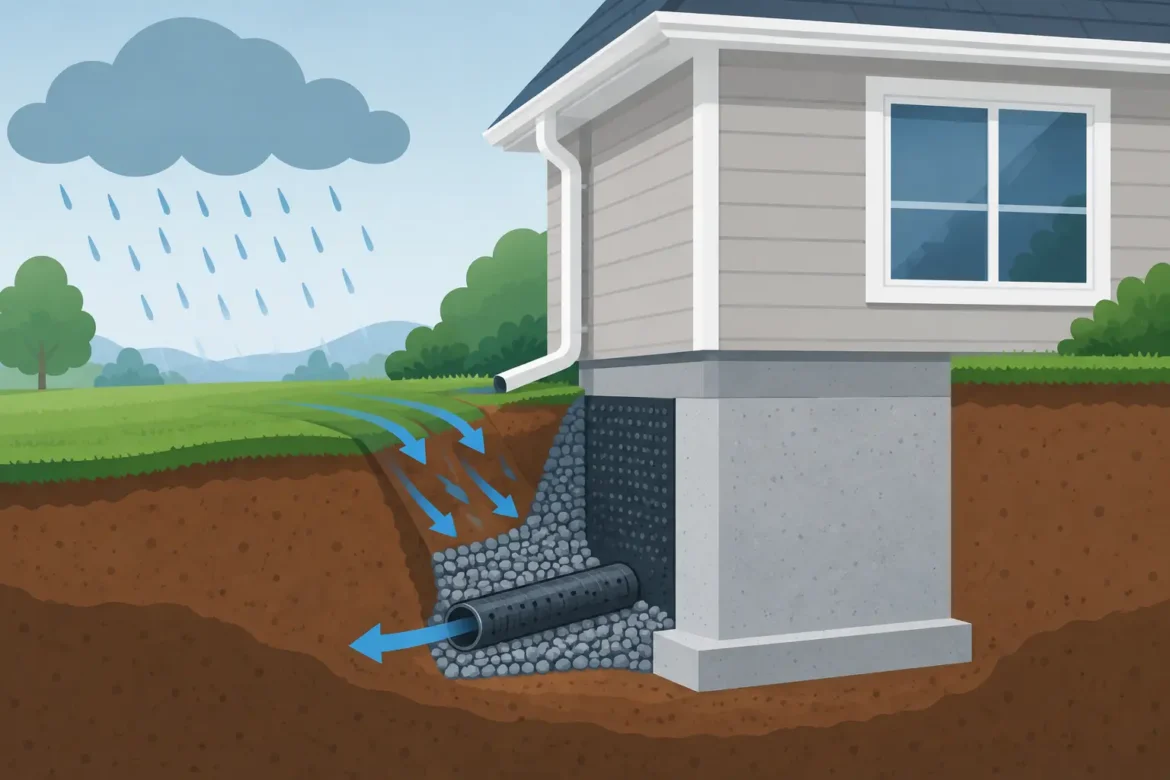
That pressure is often called hydrostatic pressure. As water collects in soil against a basement wall, it pushes against the wall and searches for an opening. Water can enter through hairline cracks, mortar joints, utility penetrations, window wells, or the joint where the wall meets the floor.
Drainage also helps limit changes in the soil itself. Wet soil expands, and dry soil contracts. In areas with clay content, these shifts can be more pronounced. Repeated expansion and contraction can place uneven stress on foundations, walks, patios, stoops, and retaining walls. Proper water management will not correct a structural foundation failure, but it can prevent a manageable water problem from becoming a more expensive repair.
The warning signs are usually outside first
Property owners often notice basement dampness first, but the site may have been showing signs for years. Water stains on a basement wall, a musty odor, peeling paint, or a sump pump that runs frequently are obvious signals. Outside, look for low spots near the home, soil that stays muddy after a storm, mulch washed out of beds, or downspouts that empty right at the foundation.
Cracks in a driveway or walkway can also tell part of the story. Not every crack is caused by poor drainage, but water beneath pavement can weaken the base, contribute to settlement, and worsen damage during freezing weather. If a driveway slopes toward the garage or house, runoff may be affecting both the pavement and the foundation area.
Other common signs include a settling paver patio, a leaning retaining wall, water collecting at the bottom of exterior steps, or erosion along the edge of a parking lot. These are not just appearance issues. They can point to water moving across the property without a controlled path.
What a proper drainage system may include
The right solution depends on where the water is coming from and where it can safely go. A drainage contractor should start by looking at the grade, roof runoff, paved surfaces, landscaping, and existing discharge areas. Installing a drain without understanding the flow of water can simply move the problem from one part of the property to another.
Grading creates the first line of defense
Whenever practical, the ground should slope away from the building. Even a modest pitch can help direct surface water away before it has a chance to pool along the foundation. This may involve reshaping soil, rebuilding landscape beds, adjusting lawn areas, or correcting settled areas beside the house.
Grading is especially valuable when the issue is broad surface runoff. However, it is not always enough on its own. Tight property lines, flat lots, patios, driveways, and neighboring drainage patterns may limit how much grading can solve.
Gutters and downspouts handle roof runoff
A roof sheds a large amount of water during a hard storm. If gutters overflow or downspouts discharge beside the foundation, that water is concentrated exactly where it should not be. Clean, properly pitched gutters and extended downspouts are basic but effective protection.
Downspout extensions need to carry water far enough away that it does not flow back toward the building. The discharge area must also drain properly. Sending water into a low spot or toward a neighbor’s property creates a different problem and may violate local requirements.
Surface drains collect water from hardscapes
Driveways, patios, walkways, and parking areas do not absorb water like a lawn. When these surfaces are pitched toward a building, trench drains, channel drains, catch basins, or area drains may be needed to collect runoff before it reaches the foundation, garage, or entryway.
These systems are particularly helpful around patio doors, basement entrances, garage doors, and low-lying paved areas. They must be installed at the correct elevation and connected to a reliable discharge route. A drain that has nowhere to drain is not a solution.
French drains address water in the soil
A French drain uses gravel and perforated pipe to collect water moving through the soil. Exterior French drains can reduce water buildup around foundation walls, while interior systems are often used when water is already entering a basement and exterior access is limited.
There are trade-offs. Exterior drainage typically addresses water before it reaches the wall, but it can require excavation and landscape restoration. Interior drainage can be less disruptive to the yard and can manage water that reaches the basement area, but it does not change the exterior grade or stop roof runoff from saturating the soil outside. In many cases, the best long-term result uses more than one measure.
Drainage and waterproofing work better together
Drainage and waterproofing are related, but they are not the same service. Drainage manages water around the property. Waterproofing helps protect the structure from water that reaches the foundation wall or basement.
A foundation coating or membrane can provide an added barrier, especially during exterior excavation. Crack repair, sealants, and interior waterproofing systems can also be appropriate depending on the source and severity of the leak. But waterproofing alone may not hold up as well if water is constantly being directed toward the house by poor grading or short downspouts.
Think of drainage as reducing the workload on the foundation. Waterproofing provides another layer of protection. When a property has recurring water issues, treating both the water source and the entry point is often the more dependable approach.
Poor drainage can affect more than the basement
Foundation protection is a major reason to correct drainage, but it is not the only one. Controlled runoff helps preserve asphalt, concrete, pavers, masonry, and landscaping. It can reduce icy patches near entries in winter, prevent slippery walkways, and keep water from undermining steps or patios.
For commercial properties, drainage problems can create liability concerns as well as repair costs. Ponding water in a parking lot can damage asphalt, interfere with access, and freeze into a hazard. Water running across a sidewalk or loading area is a maintenance issue that can affect customers, employees, and daily operations.
This is why drainage should be part of the plan whenever a driveway, patio, retaining wall, or parking area is installed or rebuilt. A new surface can look excellent on day one, but its performance depends on the base preparation, slope, and drainage around it.
When should you have the property checked?
Do not wait for a flooded basement to assess drainage. It is worth having the property evaluated if you see repeated puddling near the building, water flowing toward a garage or entry, damp basement walls, erosion, or pavement that is settling and cracking in the same area.
The best time to identify a problem is often during or shortly after a hard rain. Notice where roof water lands, where runoff collects, and how long wet areas take to dry. Those details help identify whether the main issue is roof discharge, surface slope, subsurface water, or a combination of conditions.
Bentley Paving & Masonry approaches drainage as part of the full exterior picture. The goal is not to sell a one-size-fits-all drain. It is to create a practical route for water that protects the foundation while supporting the driveway, walkways, patio, and landscape around it.
Water will always move downhill. A well-planned property gives it a safe place to go before it has a chance to work against your foundation.