A driveway should direct water away from your home, not hold it at the garage door, send it toward the basement, or leave ice patches after every New Jersey freeze. Permeable pavers for driveway drainage give rainwater a planned path through the surface and into a properly built stone base below. The result can be a cleaner-looking driveway with fewer puddles and less runoff moving across your property.
For homeowners dealing with standing water, a permeable paver driveway can be a practical alternative to a solid asphalt or concrete surface. But the pavers themselves are only part of the job. Drainage performance depends on the excavation, base material, edge restraints, grading, and the condition of the soil beneath the driveway.
How Permeable Pavers for Driveway Drainage Work
Traditional pavement is designed to shed water across the surface. If the driveway is pitched correctly, that water runs to a curb, lawn area, drain, or swale. When the pitch is poor, the drainage route is blocked, or the property has low areas, water collects where it should not.
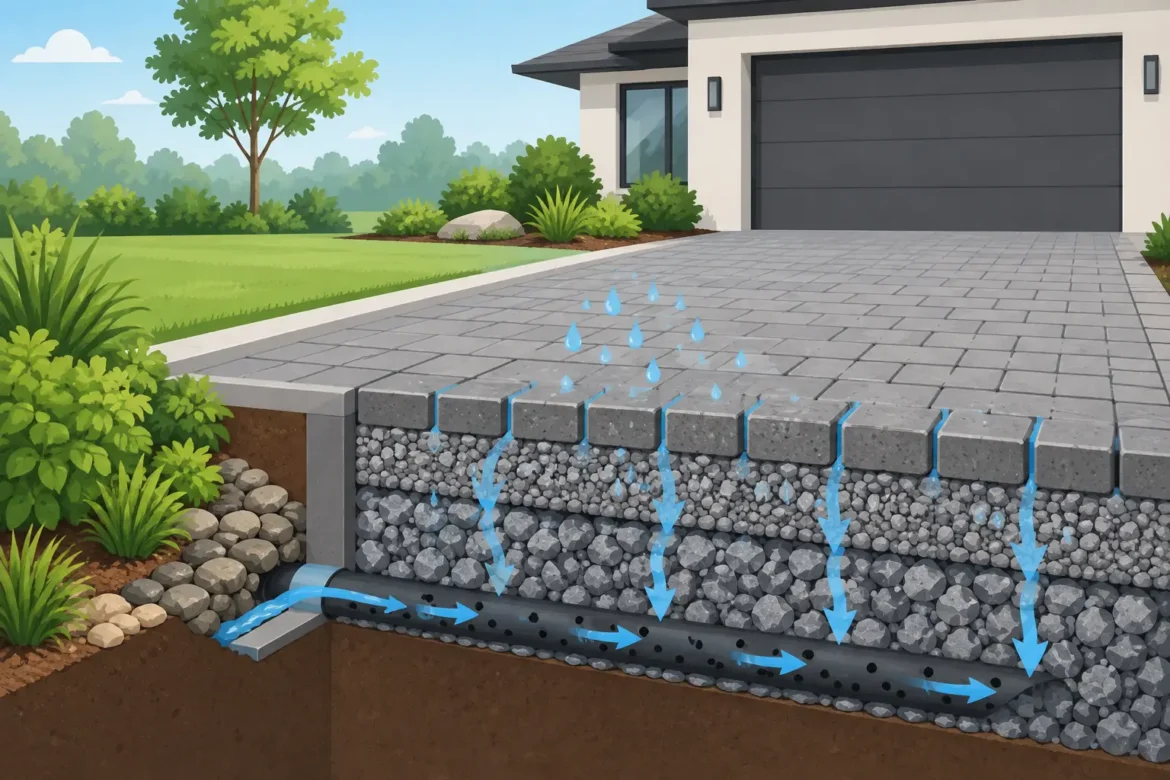
Permeable pavers work differently. Small joints between each paver are filled with clean, open-graded stone rather than regular compacted sand. Rainwater moves through those joints, passes into layers of crushed stone beneath the pavers, and either infiltrates gradually into the soil or is directed through a drainage system.
That stone base acts like a temporary underground reservoir during a storm. It holds water long enough for it to soak into the ground or travel to a properly designed outlet. This reduces the amount of water racing over the driveway surface, which is often what causes washouts, puddling, and erosion along the edges.
A well-built permeable system still needs thoughtful grading. It is not a shortcut for every drainage issue. If water is coming down a steep hill, flowing from a neighbor’s property, or collecting against the house, the project may need additional drains, swales, retaining work, or waterproofing measures.
When a Permeable Driveway Makes Sense
Permeable pavers are especially worth considering when a driveway has repeated surface-water problems but there is limited room to move runoff elsewhere. They can be a strong fit for homes with low spots near the driveway, properties where runoff crosses a walkway, and areas that become slick or icy after winter storms.
They also make sense when appearance matters. Pavers offer more color, pattern, and border options than a standard asphalt driveway. A homeowner can create a driveway that complements a brick front, stone veneer, patio, or walkway while improving how the site handles rain.
For commercial properties, permeable pavers can work well in smaller parking areas, overflow spaces, entrances, courtyard drives, and decorative sections where drainage and curb appeal are both concerns. They are not always the best answer for a heavy truck route or a large parking lot with constant commercial traffic. In those cases, conventional paving combined with engineered drainage may be the more practical choice.
The biggest question is not simply whether water can pass through the pavers. It is whether the existing soil, available outlet, traffic load, and surrounding grades support the system. A site inspection helps determine that before any materials are ordered.
The Base Is Where Drainage Performance Is Won
A permeable driveway can look great on day one and still fail early if the base is not built correctly. The work begins with removing the existing surface and excavating to the depth required for the driveway’s traffic and drainage needs. A driveway used by family vehicles needs a different base than one used by delivery trucks or heavier equipment.
The crew then installs clean, angular stone in properly compacted layers. Unlike dense road base, this material leaves void spaces for water storage and movement. A leveling layer supports the pavers, while strong edge restraints keep the field of pavers from shifting under vehicle traffic.
Depending on the property, a contractor may install drainage pipe within or alongside the stone base. This gives excess water a controlled path when the native soil drains slowly. In other locations, the water can infiltrate directly below the driveway. Neither approach is automatically better. Clay-heavy soil, a high water table, nearby foundations, and local site conditions all affect the right design.
This is why a shallow excavation and a layer of pavers over ordinary gravel is not a true permeable driveway system. It may allow some water through at first, but it will not provide enough storage, support, or reliable drainage for a vehicle surface over time.
Benefits Beyond Fewer Puddles
The most visible benefit is less standing water. That means less water splashing onto siding, fewer muddy edges, and a reduced chance of water freezing in the wheel path. It can also help protect landscaping that gets beaten up by runoff from a solid driveway.
There are longer-term property benefits as well. Managing water at the surface can reduce stress on nearby drainage systems and help keep runoff from moving toward a foundation. It may also reduce the washout that leaves voids along driveway borders or causes loose stone to migrate into the yard.
Pavers are also repair-friendly. If utility work, settlement, or damage affects one section, individual pavers can often be lifted and reset instead of replacing an entire slab. That is a meaningful advantage over cracked concrete, especially around entrances, garage aprons, and areas with underground lines.
Appearance should not be overlooked. A driveway is one of the largest visible surfaces on a property. A paver design with a clean border or a pattern that ties into existing masonry can make the front of a home feel finished, while still doing the hard work of controlling water.
Maintenance Keeps the Joints Open
Permeable pavers are durable, but they are not maintenance-free. Their drainage depends on the joints remaining open enough for water to pass through. Dirt, leaves, mulch, and fine sediment can gradually clog the joint stone, particularly under trees or near unpaved areas.
Regular sweeping and seasonal cleaning go a long way. Keep soil and mulch from washing onto the driveway, clean leaves before they break down, and avoid pushing lawn debris into the joints. If a section starts holding water longer than usual, it may need vacuum cleaning and fresh joint stone.
Winter care matters too. Use a snowplow with an appropriate blade or shoes to avoid catching the paver edges. De-icing products should be selected carefully, since harsh materials can affect nearby plantings and masonry. Avoid dumping sand across the driveway unless it can be cleaned out afterward, because fine sand is one of the materials most likely to restrict drainage.
A properly installed paver driveway should not require constant attention. The goal is simple routine care that protects the surface and keeps the drainage system doing its job.
Common Problems to Address Before Installation
A new permeable driveway cannot solve every source of water by itself. Before work begins, it is smart to look at the entire area around the drive. Downspouts that discharge at the garage corner, a patio that slopes toward the home, or a broken underground drain can send more water into the project than it was designed to handle.
The driveway layout also matters. Sometimes widening a narrow entrance, correcting the approach from the street, or adding a border drain in one problem area delivers better results than treating the whole driveway as the issue. Existing trees and roots, utility lines, and municipal requirements may affect the design as well.
At Bentley Paving & Masonry, the practical approach is to look at how water is actually moving across the property before recommending a solution. A driveway should be built for the site it sits on, not installed from a one-size-fits-all plan.
Choosing the Right Contractor and Design
Ask how deep the excavation will be, what type of aggregate will be used, and where the water will go after it enters the base. Clear answers to those questions tell you far more than a quick promise that the driveway will drain.
You should also discuss expected vehicle use, whether the soil can accept infiltration, and how the new driveway connects to walks, garage floors, lawn areas, and existing drainage. The best-looking paver pattern will not make up for poor elevation work at the garage or a base that is too thin for the load.
A quality installation takes planning, proper materials, and careful finishing around every edge. If runoff has been a constant headache, a well-designed permeable paver driveway can turn that problem area into a durable part of the property you can use with confidence after the next hard rain.